
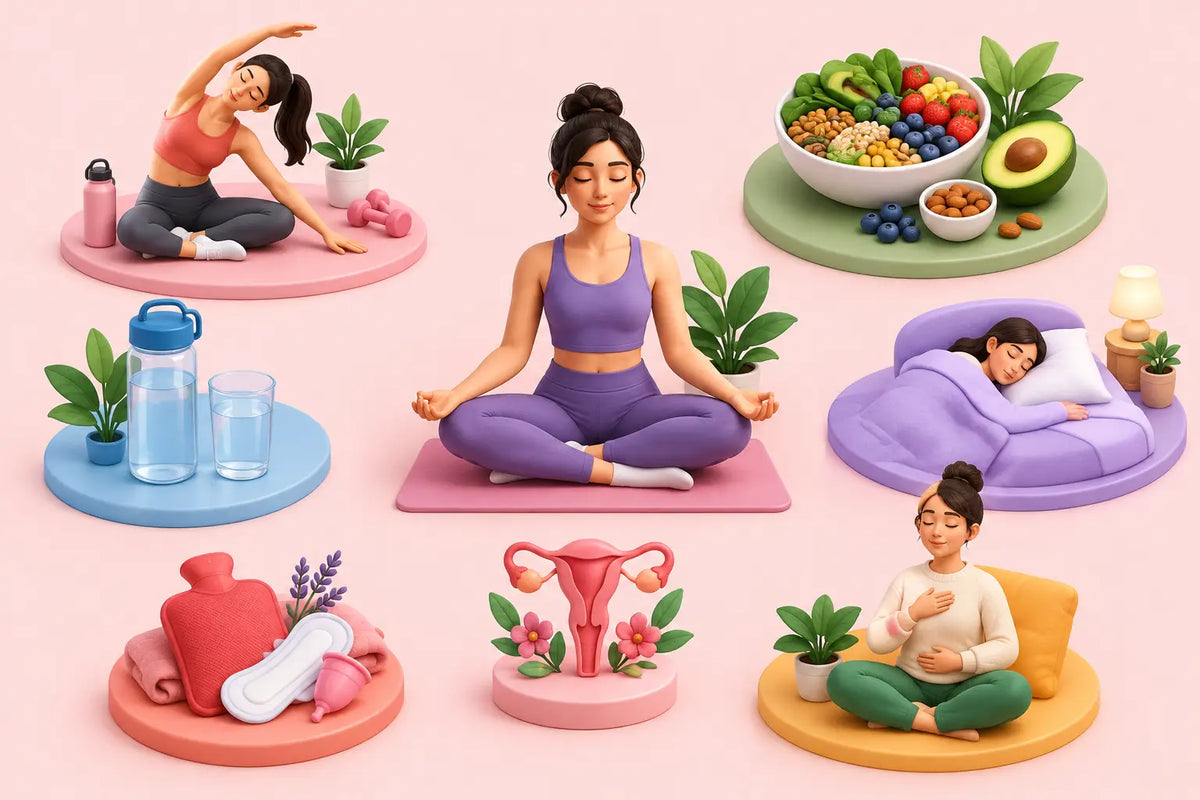
Your period is due in two days, your jeans feel rude, your patience is hanging by a thread, and someone suggests you simply “listen to your body.” Sweet sentiment. But what does that actually look like between work calls, school pickup, laundry, and the sacred morning coffee you refuse to surrender?
These menstrual wellness routine examples are designed for real life, not a fantasy schedule with two free hours for self-care. Think of them as small anchors that help you support energy, mood, digestion, stress resilience, and cycle comfort without turning your whole day into a wellness project.
Your needs can shift across the month. That does not mean your body is unpredictable or broken. It means she is communicating. The goal is not to follow every routine below perfectly. Choose the one that meets the season you are in, then repeat it often enough that it starts to feel like care instead of homework.
What makes a menstrual wellness routine work?
The best routine is usually the one with the least friction. A beautiful 12-step protocol is not useful if it only happens on your most organized Sunday. Start with something already built into your day: your coffee, your commute, your shower, the moment you close your laptop, or the snack you eat at 3 p.m. when your energy drops.
From a Traditional Chinese Medicine-inspired perspective, menstrual wellness is not just about the days you bleed. It is also about how you nourish yourself, move stress through the body, protect rest, and create steadier blood sugar in the weeks before your period arrives. Your cycle is connected to your whole system.
A routine can be supportive without being rigid. If you have irregular cycles, are in perimenopause, use hormonal birth control, are postpartum, or do not bleed every month, use symptoms like energy, sleep, cravings, digestion, mood, and tension as your guide rather than forcing yourself into a textbook phase schedule.
6 menstrual wellness routine examples for real life
1. The coffee-loving morning ritual
If coffee is the reason you get out of bed, please, Lawd, do not take it away. The point is to make your existing ritual work harder for you.
Before your first meeting, pair your coffee, chai, matcha, or tea with a real breakfast that includes protein, fiber, and fat. Eggs with toast and greens, Greek yogurt with berries and seeds, or leftovers from dinner all count. This can help soften the sharp rise-and-crash feeling that often shows up as jitters, irritability, or an emergency pastry run at 10:30.
If it fits your routine, stir a hormone-supportive formula such as SuperCube into the drink you already love. Then give yourself five unhurried minutes before opening email. No scrolling, no problem-solving, no absorbing everyone else’s urgency before your nervous system has even clocked in.
This is a particularly helpful menstrual wellness routine for people who wake up tired, run on caffeine, and notice that pre-period anxiety gets louder when meals get skipped.
2. The gentle bleed-day plan
On heavier or more uncomfortable period days, the wellness move may be doing less on purpose. That is not laziness. It is responsive care.
Build a softer rhythm around warmth, nourishment, and fewer unnecessary demands. Choose warm meals if they feel good to you: soup, oatmeal, rice bowls, roasted vegetables, stews, or eggs. Keep a water bottle nearby, and consider adding electrolytes if you are feeling drained, especially with heavier bleeding. A heating pad, warm shower, or a few minutes of lower-belly massage can become a tiny signal of safety to a tense body.
Movement is optional here. A gentle walk, hip circles, light stretching, or lying on the floor with your calves on the couch may feel better than a high-intensity class. Some people love exercise during their period and feel energized by it. Others need rest. Both experiences are valid.
The useful question is not, “What should I be able to do?” It is, “What would leave me feeling more supported an hour from now?”
3. The luteal-phase snack strategy
The week or so before your period can feel like your body suddenly acquired a megaphone. Cravings intensify. Sleep can get more fragile. Small inconveniences become deeply personal. This is a smart time to make food support easy and visible.
Try eating consistently instead of waiting until you are ravenous. Keep satisfying snacks where life actually happens: at your desk, in your bag, or in the car. Think apple slices with nut butter, cheese and crackers, edamame, trail mix, a hard-boiled egg with fruit, or hummus with pretzels and veggies. The exact snack matters less than combining carbohydrates with protein or fat for more staying power.
This is not about policing cravings. Often, cravings are information. You may need more food, more rest, more pleasure, or a little less pressure. A planned afternoon snack can be the lazy girl’s hack to avoiding the late-day energy collapse that makes everything feel emotionally louder.
4. The midcycle strength and hydration check-in
For many people, the days around ovulation bring a little more outward energy, confidence, and motivation. If that is you, use it. Book the workout class, tackle the presentation, see your friends, or cook a few components for later in the week.
But do not confuse more energy with unlimited energy. Hydration still matters, especially if you are exercising, drinking coffee, or spending time in heat. Add a glass of water when you make your morning drink and another before lunch. If plain water bores you, use citrus, mint, or an electrolyte packet you enjoy.
This routine is less about maximizing productivity and more about building a small cushion for your future self. Wash berries, prep a protein, order groceries, or put a heating pad where you can find it. Your premenstrual self will consider this a love letter.
5. The five-minute nervous system reset
Stress does not stay politely in your head. It can show up in sleep, digestion, jaw tension, cravings, cycle changes, and the feeling that you are one mildly annoying text away from a full spiral.
Choose one predictable transition point each day, such as after work or before bed. Set a five-minute timer. Put both feet on the floor and breathe slowly, making the exhale longer than the inhale. Relax your tongue from the roof of your mouth. Roll your shoulders. Put your phone in another room if you can.
If sitting still makes you twitchy, take a short walk without a podcast. If quiet feels uncomfortable, play one song and move your body until it ends. Nervous system care does not have to look serene to count. It just needs to interrupt the constant signal that you are on call for everything.
6. The cycle notes, not judgment, practice
A cycle tracker can be useful, but it is not a report card. Once a day, jot down a few words about your sleep, energy, mood, digestion, cravings, discharge or bleeding, and any pain. Keep it simple enough that you will actually do it.
After two or three cycles, patterns may become clearer. Maybe headaches arrive after skipped lunches. Maybe insomnia clusters before your period. Maybe your mood is fine until you pack every evening with obligations. These observations give you something more valuable than vague frustration: context.
Bring your notes to a qualified healthcare professional if symptoms are disruptive. Severe pain, very heavy bleeding, bleeding between periods, sudden cycle changes, fainting, or symptoms that interfere with daily life deserve medical attention. You do not need to tough it out to prove you are strong.
Make the routine yours
You do not need six new habits by Monday. Pick one ritual that feels almost too easy: breakfast with your coffee, a snack before the afternoon slump, a heating pad on day one, or five phone-free minutes before bed. Let that be enough for now.
Your body is not asking for perfection. She is asking for a little more consistency, a little more tenderness, and the kind of daily support that says, “I’m paying attention.”